I’ve been a collector my whole life. I was a kid going to card shows at the Philipsburg Mall with my best friend Brandon Warnke selling Todd Van Poppel rookie cards. I collected Valiant comics, LJN wrestling figures, and spent my childhood memorizing Beckett price guides – I was just purely “in it.” Collectibles are where I credit learning a lot of my early entrepreneurial instincts. – and carry it with me throughout my career.
Fast forward to 2018, I had a feeling that trading cards were going to enter their next major era. But, unlike the many other times I had a feeling of being on the precipice of a big moment, I was actually pretty cautious of whether or not my excitement was real, or just my childhood passion disguised as real… if it was actually happening, or if I was just excited about getting closer to one of my favorite hobbies again.
So, I attended the 2018 National Card Show, and that’s where I knew my intuition was spot on (PS – I’ve always believed the gut’s intuition is more powerful than the brain!) Starting around that time, I went deep into cards again – with vintage classics like Mikan to modern cards like Luka… I made emotional plays like Sam Darnold (that took a nice turn recently… I always knew he had “it”), staples like Joe Montana and Cassius Clay rookies… I became obsessed with certain cards – alternative rookie cards like Hank Aaron’s Johnston’s Cookies card, and sets like 2013 Kaboom.
But alongside sports cards, I’ve always had a huge appreciation for non-sports cards. It’s a big category; there are cards of historical figures… music… TV… but the category that I naturally loved was what I call “Fictional Character Cards.” If you follow my content, you know I’ve always been a fan of IP, growing up in the Golden Age of it in the 80s with He-Man, Thundercats, and Transformers to name a few.
But, there wasn’t a lot of attention towards those types of cards. I started thinking more about these characters and what their “Rookie Cards” may be… I thought “Way more people love Shrek compared to Elly De La Cruz, yet nobody knows what Shrek’s first card is…” and so I just kept learning. Super hero cards were key to me – I recently came across a tweet I made 5 years ago, learning about Superman’s first card. I didn’t get my first one until a couple of years later. To me, it’s all about “homework.”
That homework comes also by attending many of the biggest events on both sides of the spectrum; New York Comic Con on the non-sports side, and the National Sports Collectors Convention – the biggest card show in the world, and what’s interesting and I’ve noticed firsthand is how those two communities are starting to collide.
I’ve felt it and I predict it happening more and more – it’s why I loved the Kaboom set in 2013 with a card and comic crossover, it’s why Topps and others have been growing their non-sports card categories – between sports and pop culture characters – there’s so much in common – passion at the forefront, nostalgia, rarity, story, and many starting to see the top tier collectibles as alternative investments. In many ways, what I’ve outlined here is how I’ve navigated my whole career as an entrepreneur – when you’re “in the dirt” and seeing the day by day and talking to collectors, I felt this starting to happen, and strengthened my conviction in collecting these fictional character cards.
Fictional character card collecting is growing in the modern market. Topps has made signature sets with Marvel, Disney, Pixar, and Star Wars – providing much more awareness around the ability for all fans to collect; not just sports fans. The fictional card collecting space in particular is welcoming many new collectors every day. That’s why, while there are many character rookies I’m looking forward to sharing, there’s one that sticks out above the rest. When a category like this grows, eventually, collectors start looking backward. They ask the same question collectors always ask: “Where did this begin?”
When it comes to Marvel, the answer leads to one specific set.
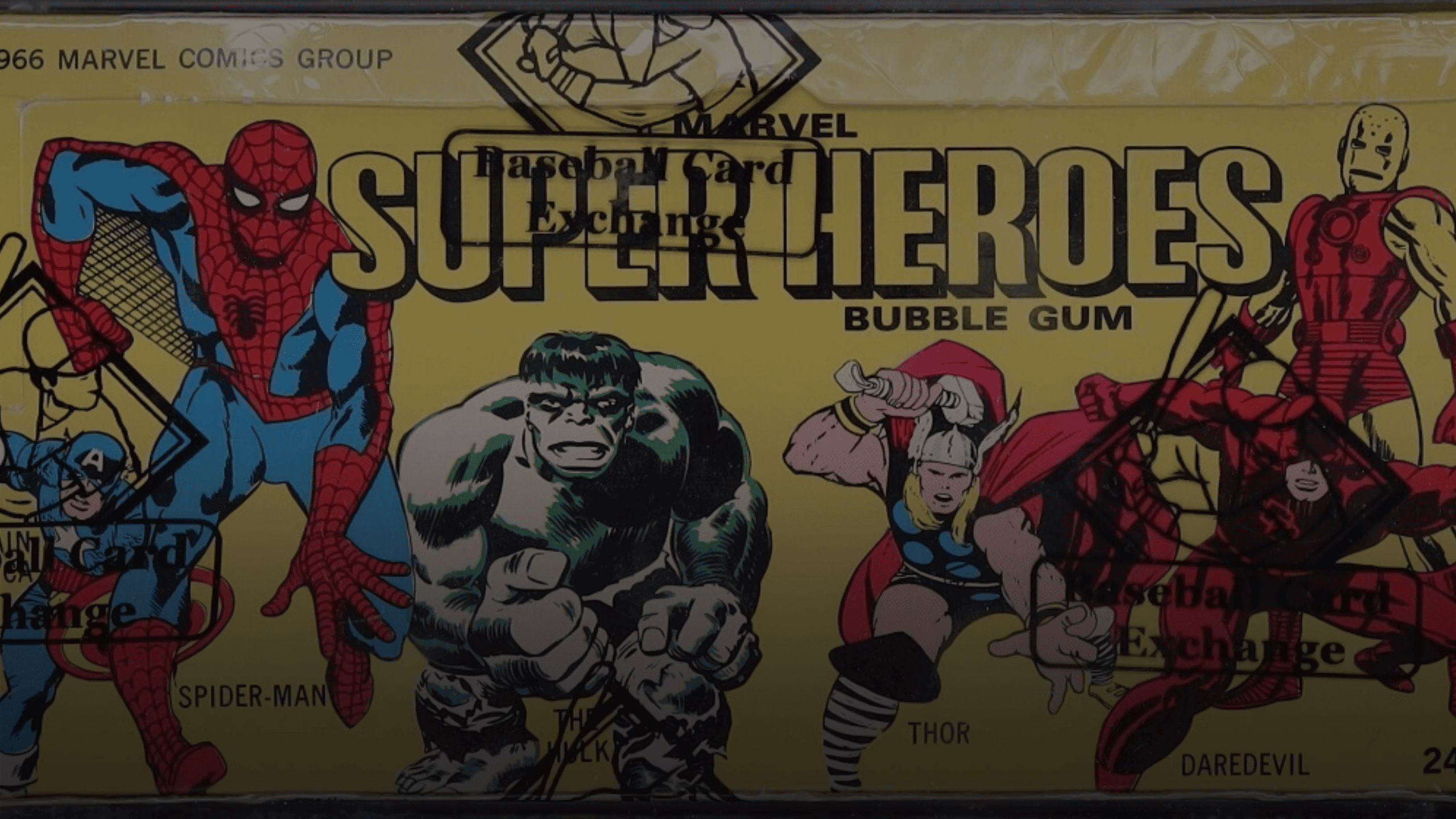
The 1966 Donruss Marvel Super Heroes set.
In my opinion, while it’s already gained more momentum because of everything I’ll lay out here, it’s one of the most underrated sets in all of trading cards. And just to be clear: this is not financial advice nor do I have any clue what’s going to happen, especially in the macro economy, let alone the micro economy of trading cards. But, I’m enjoying going deeper in my content in depth on things that I see, share, and collect with the hopes that in a 10, 20, or 30 year window, this article can be historically correct. I like challenging myself to those things, and I also like sharing with the people that are aware of or follow my content. I also hope it gives some of you a new perspective on different ways to go about collecting for yourself.
About the Set
They’re the first Marvel cards ever made. The set was released in 1966 by Donruss, a popular card manufacturer that was eventually acquired by Panini, one of the leading global card makers. At the time, packs cost five cents for 5 cards and a piece of bubble gum. A box contained 24 packs. It’s a simple set: 66 total cards – an even split of 6 Super Heroes each with 11 cards. The card backs when pieced together form a puzzle.
As cards are typically treated, and the consensus view for this set, the first card of each character’s run is considered the first appearance, aka Rookie card.
The Six Super Heroes:
Captain America (Cards 1–11) | Rookie Card: #1
Source: eBay
Iron Man (Cards 12–22) | | Rookie Card: #12
Source: eBay
Daredevil (Cards 23–33) | | Rookie Card: #23
Source: eBay
Spider-Man (Cards 34–44) | Rookie Card: #34 (By the way, this features Spider-Man alongside the first card of Johnny Storm AKA The Human Torch!)
Source: eBay
Hulk (Cards 45–55) | Rookie Card: #45
Source: eBay
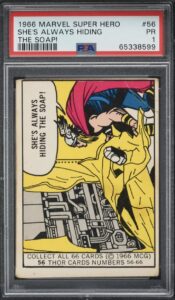
Thor (Cards 56–66) |Rookie Card: #56
Source: My personal collection.
And one detail I personally love: Card #1 is Captain America. That means it’s not only Captain America’s first trading card, but actually the first Marvel card ever made. Plus, the set just looks rad. Some cards more than others, but it’s an awesome crossover between cards and comics and some of the world’s most beloved characters.
The “Rookie Card” Idea
In sports cards, rookie cards are important collectibles for every player. What has historically differed with Marvel characters is that many collectors are focused on comic books, because that’s where the characters originated. Let there be no confusion… I am also a massive believer in comic books, especially the first appearances, but as card collecting continues to grow in pop culture, I have full belief that the first cards for these significant characters are going to matter.Marvel collecting has always been big – it’s one of the most incredible and passionate fanbases in the world. Brands like Upper Deck, and before that, Impel and Skybox, have created many collectible sets, and now Topps where the card collecting genre is getting more integrated, making the first appearance Marvel cards gain more popularity.So while huge Captain America fans may know about his first comic appearance, most do not know his first trading card. What’s interesting is that the card side of things never really got the same attention, even though this set clearly contains the first appearance cards for these characters. Now that card collecting is crossing over to the comic book and “nerd culture ecosystem” I think more and more fandom and demand will draw toward these cards.
Scarcity and Condition
I love how this set has a blend of significance, organic scarcity, and condition sensitivity. These cards were printed in 1966, when printing wasn’t as advanced and it was common to see centering issues right out of the pack. On top of that, these were five-cent packs, often intended for kids. At the time, nobody treated them as collectibles or investments; people opened them, stuck them in pockets, bike spokes, traded them – not placing them into sleeves and top loaders like many do today. Because of that, finding cards in great condition is difficult, and makes them even more sought after.
To make the set even more interesting, some cards were designed as “write-your-own” comic panels, where you could fill in the dialogue. Accordingly, many cards literally have writing on them. The only Rookie impacted by this is Hulk with card #45.
All this said, when you look at the selection of this set’s graded cards today, high-grade examples are extremely rare. If you’d like to see the full record of grades for this set, check them out with the major grading companies: PSA | CGC | SGC. These 3 elements – older manufacturing, organic scarcity of cards being lost or damaged over time, and the “write your owns” gives it enormous upside to grow in value given the supply and demand elements I see coming true.
The Cultural Relevance
The staying power of these Super Heroes are a huge reason why this set matters so much. Sports cards are amazing, but one reality of them is that every year new rookies enter the league and take over as the hot new things across that year of card products. The players don’t always have as much staying power in culture – it’s why I also love collecting the legends and vintage sports rookies.
But at the same time, those legends of the 60’s – Reggie Jackson, Gale Sayers, Elgin Baylor, Bobby Orr – they aren’t relevant in today’s day and age the same way Captain America, Spiderman, Iron Man and Hulk remain today- that’s a fascinating nuance in why this Marvel set is so key. These characters have been culturally relevant for decades, and they’re still everywhere in movies, games, comics, and pop culture.
“Unlike Wilt Chamberlain, one of the icons of the game, most people under 40 today have no context of his greatness or his impact because obviously he hasn’t played since 1973. Yet in three years, a new Spider-Man adaption can come out in AI video game or app form and his popularity will continue to grow. This is why fictional collecting has a substantial advantage over humans from a relevancy standpoint.”
Don’t get me wrong, deep Marvel and non sports fans did know of this set, but even as cards started to take off, this set stayed under the radar for a few reasons. In my opinion, it’s because the comic book world and the trading card world were separate ecosystems; the prior collectors didn’t always look out for Rookie cards, the category was a lot smaller (pre-Topps), and character focus was mainly in comics and not cards. Now, there’s more crossover in the space than ever before, with more attention on modern cards that’s bringing in new collectors and adding more significance to these first appearances.
Why Interest Is Growing
Over the last few years, interest in broader collectibles, and then specifically non-sports trading cards has grown exponentially. Topps have started producing modern Marvel card releases that are doing two things: bringing Marvel fans into cards, and bringing passionate card collectors and investors into Marvel. Those releases bring new collectors into the hobby, and once people get interested in modern cards, they often start looking backward to see where everything began.
When you trace Marvel trading cards backward, everything leads to the same place: 1966 Donruss Marvel Super Heroes.
It’s Already Starting to Happen
I can already see the market wake up to this set based on eBay sales.
Take the Spider-Man rookie card (#34) as an example in PSA 5 condition — I bought one in August 2024 for $415 in an eBay auction. I just bought another one last month for $2,500, and I’m just as excited about it. Why? Because when I compare these cards to modern Marvel releases that sell for significant money right out of the gate, it starts to put things into perspective.
The same goes for vintage sports rookies from the same era. I have a huge Wilt Chamberlain rookie collection; it’s one of my favorite cards ever. PSA has graded 2,270 Wilt rookies, which is still very scarce. But compared to Spider-Man’s rookie card from this set? Under 400 have been graded at the time of writing this article. That kind of rarity just excites the hell out of me – and we’re talking about Spider-Man here — arguably the most popular Marvel character in the world.
With all the history, the characters, and the scarcity, it still feels like the broader market hasn’t fully caught up yet. And that’s exactly why I continue to believe the 1966 Donruss Marvel Super Heroes set remains extremely underrated.
The Big Idea
I’ve been in love with this set because all the pieces make sense and work together. You have:
The first Marvel trading cards ever made
Featuring six of the most iconic superheroes in pop culture
Printed in 1966, when nobody thought about preserving them
Scarcity driven by age and condition
The set just looks rad and is a key intersection between cards and pop culture
And most importantly, my anticipation of extraordinary demand acceleration
Which is why I believe as more collectors enter the fictional character card space — and as Marvel collecting continues to grow — more people are going to pay attention to where the card side of Marvel actually began.
And that story begins with 1966 Donruss Marvel Super Heroes, which might just be the most underpriced trading card set on the planet.